
GHK-Cu in Australia
GHK-Cu is available in Australia as a research-grade lyophilised vial for laboratory use, in 2 sizes from $99.99 (50mg) to $149.99 (100mg), shipped from Peptide Aus stock. It is not approved for human use.
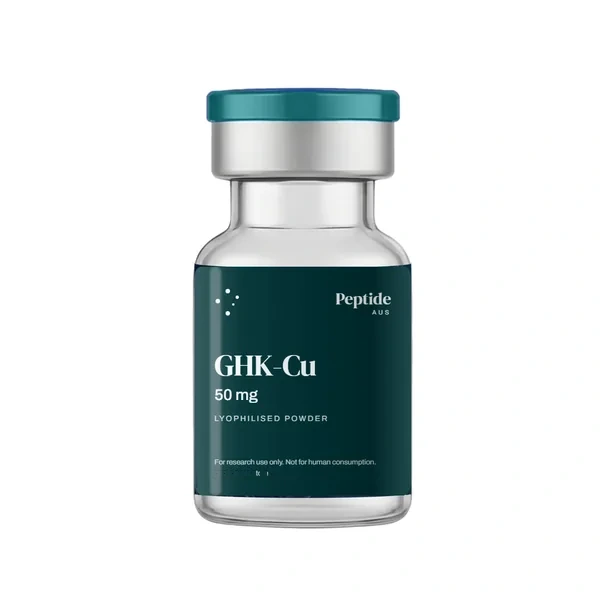
Vial sizes and prices
| Product | Price | Per mg | Stock |
|---|---|---|---|
| GHK-Cu (50mg) | $99.99 | $2.00/mg | In Stock |
| GHK-Cu (100mg) | $149.99 | $1.50/mg | In Stock |
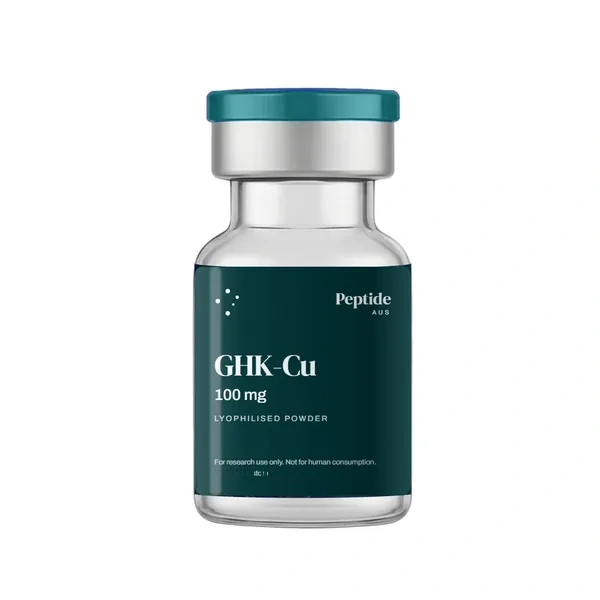
What GHK-Cu is
Copper-binding tripeptide (glycyl-L-histidyl-L-lysine:Cu²⁺)
GHK-Cu is a tripeptide that occurs in nature and binds copper with high affinity. First isolated from human plasma in 1973, its concentration drops from around 200 ng/mL in young adults to roughly 80 ng/mL by age 60. Researchers study it across wound repair, collagen synthesis, hair follicle biology and gene-expression changes in aged tissue. The same molecule turns up at low levels in cosmetic serums; the research vial holds the pure copper complex.
How it works
GHK-Cu hands copper to enzymes that depend on it, among them lysyl oxidase, which cross-links collagen and elastin, and superoxide dismutase. Separately from that copper delivery, the peptide attaches to DNA-regulatory sites: a wide-ranging gene-expression study (Pickart et al., Oxid Med Cell Longev 2012) reported that it reset expression of several thousand genes toward a younger profile in cultured cells, including genes tied to tissue remodelling and antioxidant defence.
What the research reports
Animal wound studies and small human trials reported quicker closure and more collagen deposition. Controlled facial studies of topical GHK-Cu creams reported better skin thickness, elasticity and fine-line depth over 12 weeks. Hair studies show larger follicles in culture and in animal models. The bulk of the data is topical or in-vitro, with injectable research confined to preclinical work.
Key research areas
- Collagen and elastin synthesis — Fibroblast stimulation and lysyl oxidase activity
- Wound healing — Closure rate and remodelling in animal and human wounds
- Gene expression — Wide transcriptional effects in aged and cancer cell lines
- Hair follicle biology — Follicle size and growth-phase markers
- Antioxidant defence — SOD activation and inhibition of iron release
Also known as: Copper peptide, GHK copper, GHKCu, Copper tripeptide-1, ghku, chk cu, ghcku, copper tripeptide-1
GHK-Cu dosage: what the published studies used
The table lists the amount, frequency and duration each GHK-Cu study reports, in the model it used. Most peptide research is animal or cell work, so the model column matters as much as the number. These figures describe the research. They are not a recommendation, and Peptide Aus does not give dosing advice for people.
| Study | Model | Amount used | How often | Duration |
|---|---|---|---|---|
| Pollard JD et al. (2005) | Cell culture, human dermal fibroblasts | 1 × 10⁻⁹ mol/L | — | — |
GHK-Cu vial maths
| Vial | Bacteriostatic water | Concentration | Per 0.01 mL (1 unit, U-100) |
|---|---|---|---|
| 50mg | 3 mL | 16.7 mg/mL | 167 mcg |
| 100mg | 3 mL | 33.3 mg/mL | 333 mcg |
How to reconstitute GHK-Cu
GHK-Cu ships as a lyophilised (freeze-dried) powder and is reconstituted with bacteriostatic water before laboratory use. Volumes used on this page: 50mg: 3 mL · 100mg: 3 mL.
- Let the vial reach room temperature. Take it out of the freezer about 15 minutes beforehand so condensation doesn't form inside.
- Swab both stoppers. Wipe the GHK-Cu vial and the bacteriostatic water vial with an alcohol swab and let them dry.
- Draw the water. Use a fresh syringe to draw the volume for your vial size from the bacteriostatic water vial.
- Add it slowly down the inside wall. Aim the stream at the glass, not at the powder, so the cake dissolves without foaming.
- Swirl, don't shake. Roll the vial gently between your fingers until the solution is clear. Shaking can damage the peptide.
- Label and refrigerate. Write the date and concentration on the vial and store it at 2–8 °C, protected from light. Never freeze reconstituted solution.
- Work out the concentration. The vial maths table above, or the calculator, converts milligrams and millilitres into mg/mL and syringe units.
Is GHK-Cu legal in Australia?
GHK-Cu is allowed in cosmetics at topical concentrations, yet no injectable or research-grade GHK-Cu product has approval for human use in Australia. Peptide Aus supplies the vial for in-vitro laboratory research only.
Frequently asked questions
What is GHK-Cu?
Copper-binding tripeptide (glycyl-L-histidyl-L-lysine:Cu²⁺). GHK-Cu is a tripeptide that occurs in nature and binds copper with high affinity. First isolated from human plasma in 1973, its concentration drops from around 200 ng/mL in young adults to roughly 80 ng/mL by age 60. Researchers study it across wound repair, collagen synthesis, hair follicle biology and gene-expression changes in aged tissue. The same molecule turns up at low levels in cosmetic serums; the research vial holds the pure copper complex.
What is GHK-Cu studied for?
Collagen and elastin synthesis: fibroblast stimulation and lysyl oxidase activity. Wound healing: closure rate and remodelling in animal and human wounds. Gene expression: wide transcriptional effects in aged and cancer cell lines. Hair follicle biology: follicle size and growth-phase markers. Antioxidant defence: sOD activation and inhibition of iron release. Animal wound studies and small human trials reported quicker closure and more collagen deposition. Controlled facial studies of topical GHK-Cu creams reported better skin thickness, elasticity and fine-line depth over 12 weeks. Hair studies show larger follicles in culture and in animal models. The bulk of the data is topical or in-vitro, with injectable research confined to preclinical work.
GHK-Cu before and after: what do the studies show?
Twelve-week controlled facial studies reported greater skin thickness and density on ultrasound, better elasticity and shallower wrinkle depth on profilometry; wound studies reported quicker closure; follicle cultures showed larger follicles. The human evidence is topical.
What side effects has GHK-Cu research reported?
Topical GHK-Cu is well tolerated across the published trials, with the odd case of mild irritation. No human safety data exist for injectable use; copper exposure from the peptide is on a microgram scale and bound.
What is the GHK-Cu dosage?
In the published GHK-Cu research, the amounts used were 1 × 10⁻⁹ mol/L in cell culture, human dermal fibroblasts (Pollard JD et al. (2005)). These are the figures each study reports for its own model, listed in full in the dosage table on this page with links to PubMed. Peptide Aus supplies GHK-Cu for in-vitro research and does not give dosing guidance for people.
GHK-Cu serum, cream or the research vial?
Cosmetic serums and creams at 0.01-0.1% are the form the human skin studies relied on. The vial is the unformulated copper complex for bench work and formulation development.
GHK-Cu vs copper peptides: what is the difference?
In skincare, 'copper peptides' usually means GHK-Cu, occasionally AHK-Cu; GHK-Cu is the one carrying the research record.
GHK-Cu vs AHK-Cu: what is the difference?
AHK-Cu is a separate copper tripeptide studied mostly for hair; GHK-Cu holds the wider skin and wound literature.
GHK-Cu vs GLOW: what is the difference?
GLOW blends GHK-Cu with BPC-157 and TB-500 for combined skin and repair research.
Topical GHK-Cu serum or the research vial?
Cosmetic serums carry GHK-Cu at low concentrations in a formulated base meant for the skin, and that is the form behind most of the human skin data. The lyophilised vial is the unformulated copper complex, supplied with a batch certificate on request and intended for laboratory study at concentrations a serum could never reach. Our topical-versus-injectable guide walks through the difference.
What does GHK-Cu 'before and after' research really measure?
The published studies track skin thickness by ultrasound, elasticity by cutometer, wrinkle depth by profilometry, wound area, and follicle diameter in hair models. Our evidence guide lays out the endpoints and how large the reported changes were.
Is GHK-Cu legal in Australia?
At topical concentrations as a cosmetic ingredient, yes, and it appears in registered cosmetics. Injectable or research-grade GHK-Cu, however, is not approved for human use in Australia. Peptide Aus supplies the vial for in-vitro research only.
50mg or 100mg?
Go with the 50mg vial for shorter cell-culture or topical-formulation work. The 100mg vial cuts the cost per milligram by roughly half for longer protocols.
How do you reconstitute GHK-Cu?
With bacteriostatic water added slowly down the inside wall of the vial, then swirled gently. Each vial size lists its suggested volume, and the calculator converts volume to concentration.
How should GHK-Cu be stored?
Lyophilised: −20 °C, sealed, away from light and moisture. Reconstituted: 2–8 °C, used within 8–12 weeks, never frozen.
Is GHK-Cu legal in Australia?
GHK-Cu is allowed in cosmetics at topical concentrations, yet no injectable or research-grade GHK-Cu product has approval for human use in Australia. Peptide Aus supplies the vial for in-vitro laboratory research only.
Where can I buy GHK-Cu in Australia, and what does it cost?
Directly from Peptide Aus, from Australian stock, in 2 vial sizes from $99.99 (50mg) to $149.99 (100mg). Prices are AUD and GST inclusive. Paid orders before 2pm AEST/AEDT dispatch the same business day, tracked.
How much bacteriostatic water do you add to GHK-Cu?
It depends on the vial size: 50mg takes 3 mL, 100mg takes 3 mL. That gives 16.7 mg/mL, 33.3 mg/mL respectively. The reconstitution steps on this page and the calculator cover the rest.
Kits with this compound

Build-Your-Own GLOW
GHK-Cu 50mg plus the BPC-157 + TB-500 blend, with water, forty syringes and swabs: GLOW's components as separate vials.
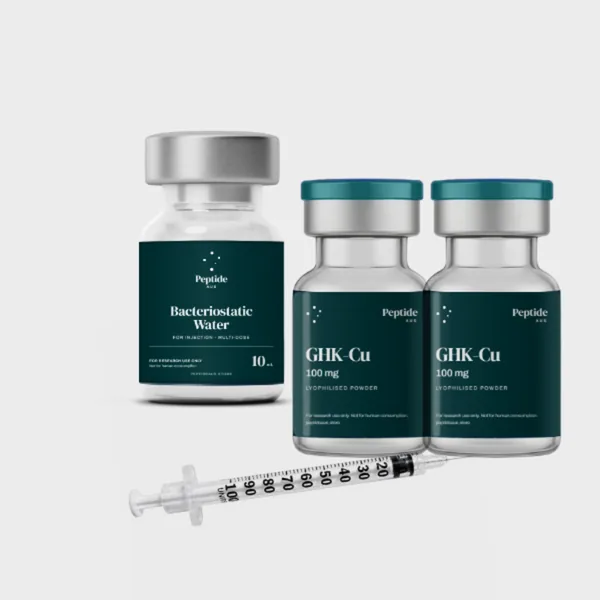
GHK-Cu Skin Pack (2 x 100mg)
Two GHK-Cu 100mg vials with water, sixty syringes and swabs, for longer skin and cellular protocols.
All GHK-Cu products are supplied for in-vitro research and laboratory use only. Not for human or veterinary use.