
Tesamorelin in Australia
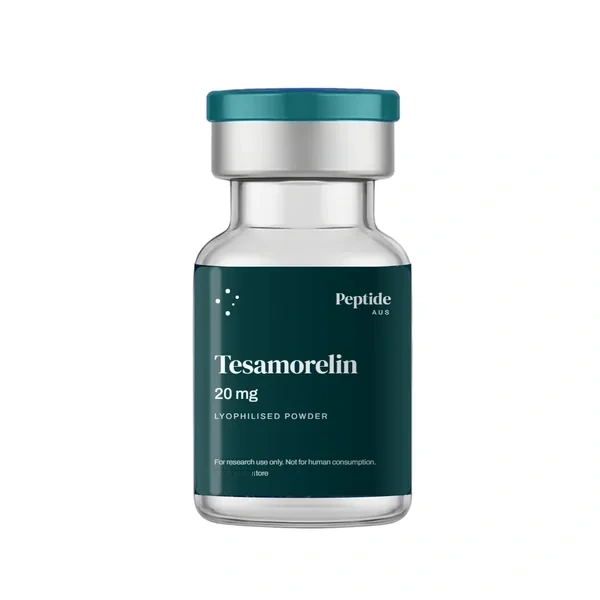
Tesamorelin is available in Australia as a research-grade lyophilised vial for laboratory use, in 3 sizes from $89.99 (5mg) to $259.99 (20mg), shipped from Peptide Aus stock. It is not approved for human use.
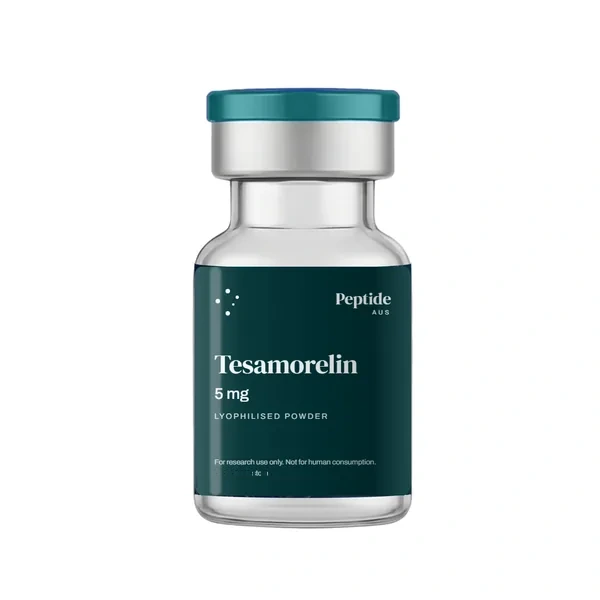
Vial sizes and prices
| Product | Price | Per mg | Stock |
|---|---|---|---|
| Tesamorelin (5mg) | $89.99 | $18.00/mg | In Stock |
| Tesamorelin (10mg) | $145.99 | $14.60/mg | In Stock |
| Tesamorelin (20mg) | $259.99 | $13.00/mg | In Stock |

What Tesamorelin is
Stabilised growth-hormone-releasing hormone analogue
Tesamorelin is a 44-amino-acid GHRH analogue carrying a trans-3-hexenoic acid group on its N-terminus that shields it from enzymatic breakdown. Its reputation comes from the HIV-associated lipodystrophy trials, in which it cut visceral abdominal fat while avoiding the wider metabolic effects that recombinant growth hormone tends to produce.
How it works
By binding the GHRH receptor on pituitary somatotrophs, tesamorelin prompts pulsatile growth-hormone release, which in turn lifts IGF-1. The pituitary feedback loop stays intact, so GH output keeps its natural rhythm instead of the steady, flat rise that injected GH causes. Visceral adipose tissue seems especially sensitive to this kind of signalling.
What the research reports
Two Phase 3 trials (Falutz et al., NEJM 2007 and JCEM 2010) reported an average 15-18% cut in visceral adipose tissue over 26 weeks in HIV-associated lipodystrophy, together with lower triglycerides and no meaningful change in subcutaneous fat. Later studies turned to liver fat in NAFLD and to cognitive endpoints in older adults.
Key research areas
- Visceral adiposity — VAT measured by CT across the Phase 3 program
- GH and IGF-1 axis — Pulsatile GH release with the feedback loop left intact
- Hepatic fat — Liver-fat fraction in HIV-associated NAFLD
- Body composition — Trunk fat set against limb lean mass on DEXA
- Cognitive research — Executive-function endpoints studied in older adults
Also known as: TH9507, Egrifta (US brand), Egrifta (brand)
Tesamorelin dosage: what the published studies used
The table lists the amount, frequency and duration each Tesamorelin study reports, in the model it used. Most peptide research is animal or cell work, so the model column matters as much as the number. These figures describe the research. They are not a recommendation, and Peptide Aus does not give dosing advice for people.
| Study | Model | Amount used | How often | Duration |
|---|---|---|---|---|
| Falutz J et al. (2010) | Human, people with HIV and excess abdominal fat (n=404) | 2 mg s.c. | Once daily | 6 months plus 6-month extension |
| Falutz J et al. (2008) | Human, people with HIV and central fat accumulation (n=410) | 2 mg s.c. | Once daily | 26 weeks plus 26-week extension |
| Stanley TL et al. (2014) | Human, people with HIV and abdominal fat accumulation (n=50) | 2 mg s.c. | Once daily | 6 months |
| Stanley TL et al. (2019) | Human, people with HIV and fatty liver disease (n=61) | 2 mg | Once daily | 12 months plus 6-month open-label phase |
| Clemmons DR et al. (2017) | Human, type 2 diabetes (n=53) | 1 or 2 mg | — | 12 weeks |
| González-Sales M et al. (2015) | Human, people with HIV and healthy subjects, phase 1 pharmacokinetics (n=38) | 1 or 2 mg s.c. | Once daily | 14 days |
Tesamorelin vial maths
| Vial | Bacteriostatic water | Concentration | Per 0.01 mL (1 unit, U-100) |
|---|---|---|---|
| 5mg | 1 mL | 5 mg/mL | 50 mcg |
| 10mg | 1 mL | 10 mg/mL | 100 mcg |
| 20mg | 2 mL | 10 mg/mL | 100 mcg |
How to reconstitute Tesamorelin
Tesamorelin ships as a lyophilised (freeze-dried) powder and is reconstituted with bacteriostatic water before laboratory use. Volumes used on this page: 5mg: 1 mL · 10mg: 1 mL · 20mg: 2 mL.
- Let the vial reach room temperature. Take it out of the freezer about 15 minutes beforehand so condensation doesn't form inside.
- Swab both stoppers. Wipe the Tesamorelin vial and the bacteriostatic water vial with an alcohol swab and let them dry.
- Draw the water. Use a fresh syringe to draw the volume for your vial size from the bacteriostatic water vial.
- Add it slowly down the inside wall. Aim the stream at the glass, not at the powder, so the cake dissolves without foaming.
- Swirl, don't shake. Roll the vial gently between your fingers until the solution is clear. Shaking can damage the peptide.
- Label and refrigerate. Write the date and concentration on the vial and store it at 2–8 °C, protected from light. Never freeze reconstituted solution.
- Work out the concentration. The vial maths table above, or the calculator, converts milligrams and millilitres into mg/mL and syringe units.
Is Tesamorelin legal in Australia?
Tesamorelin holds no Australian registration and has no approved human use here. Peptide Aus supplies it for in-vitro laboratory research only, and lawful use rests with the buyer.
Frequently asked questions
What is Tesamorelin?
Stabilised growth-hormone-releasing hormone analogue. Tesamorelin is a 44-amino-acid GHRH analogue carrying a trans-3-hexenoic acid group on its N-terminus that shields it from enzymatic breakdown. Its reputation comes from the HIV-associated lipodystrophy trials, in which it cut visceral abdominal fat while avoiding the wider metabolic effects that recombinant growth hormone tends to produce.
What is Tesamorelin studied for?
Visceral adiposity: vAT measured by CT across the Phase 3 program. GH and IGF-1 axis: pulsatile GH release with the feedback loop left intact. Hepatic fat: liver-fat fraction in HIV-associated NAFLD. Body composition: trunk fat set against limb lean mass on DEXA. Cognitive research: executive-function endpoints studied in older adults. Two Phase 3 trials (Falutz et al., NEJM 2007 and JCEM 2010) reported an average 15-18% cut in visceral adipose tissue over 26 weeks in HIV-associated lipodystrophy, together with lower triglycerides and no meaningful change in subcutaneous fat. Later studies turned to liver fat in NAFLD and to cognitive endpoints in older adults.
Tesamorelin before and after: what do the studies show?
The Phase 3 trials reported an average 15-18% reduction in visceral adipose tissue on CT at 26 weeks, with triglycerides falling and subcutaneous fat essentially unchanged; visceral fat drifted back toward baseline once the compound was stopped.
What side effects has Tesamorelin research reported?
The most frequently reported events in the Phase 3 program were injection-site reactions (redness, itching), joint pain, peripheral oedema and paraesthesia. Since tesamorelin pushes IGF-1 up, the registered product's labelling notes that this was monitored in the trials.
What is the Tesamorelin dosage?
In the published Tesamorelin research, the amounts used were 2 mg s.c., Once daily in human, people with hiv and excess abdominal fat (Falutz J et al. (2010)); 2 mg s.c., Once daily in human, people with hiv and central fat accumulation (Falutz J et al. (2008)); 2 mg s.c., Once daily in human, people with hiv and abdominal fat accumulation (Stanley TL et al. (2014)). These are the figures each study reports for its own model, listed in full in the dosage table on this page with links to PubMed. Peptide Aus supplies Tesamorelin for in-vitro research and does not give dosing guidance for people.
Tesamorelin vs ipamorelin: what is the difference?
Ipamorelin works at the ghrelin receptor, tesamorelin at the GHRH receptor. Both lift GH, but tesamorelin's evidence rests on the visceral-fat trials.
Tesamorelin vs CJC-1295: what is the difference?
CJC-1295 is another GHRH analogue; its DAC form is long-acting, whereas tesamorelin is stabilised yet short-acting and backed by a clinical trial record.
Tesamorelin vs sermorelin: what is the difference?
Sermorelin is unmodified GHRH (1-29) that lasts only minutes; the N-terminal modification on tesamorelin protects it from being broken down.
Is tesamorelin approved in Australia?
No. It holds a United States registration (as Egrifta) for a narrow HIV-related indication, but the TGA has not registered it, so Australian pharmacies and prescribers cannot supply it. Peptide Aus provides research-grade tesamorelin for laboratory use alone.
How is tesamorelin unlike the GLP-1 peptides?
GLP-1 compounds cut food intake and drive broad weight loss. Tesamorelin leaves appetite alone; what the published work shows is a focused reduction in visceral fat through the GH axis, with subcutaneous fat and total weight barely moving.
5mg, 10mg or 20mg?
The 5mg format is the smallest, suited to first-run assays; 10mg fits shorter protocols; and 20mg delivers the lowest cost per milligram for extended work. All three are drawn from CoA-verified batches.
How do you reconstitute Tesamorelin?
With bacteriostatic water added slowly down the inside wall of the vial, then swirled gently. Each vial size lists its suggested volume, and the calculator converts volume to concentration.
How should Tesamorelin be stored?
Lyophilised: −20 °C, sealed, away from light and moisture. Reconstituted: 2–8 °C, used within 8–12 weeks, never frozen.
Is Tesamorelin legal in Australia?
Tesamorelin holds no Australian registration and has no approved human use here. Peptide Aus supplies it for in-vitro laboratory research only, and lawful use rests with the buyer.
Where can I buy Tesamorelin in Australia, and what does it cost?
Directly from Peptide Aus, from Australian stock, in 3 vial sizes from $89.99 (5mg) to $259.99 (20mg). Prices are AUD and GST inclusive. Paid orders before 2pm AEST/AEDT dispatch the same business day, tracked.
How much bacteriostatic water do you add to Tesamorelin?
It depends on the vial size: 5mg takes 1 mL, 10mg takes 1 mL, 20mg takes 2 mL. That gives 5 mg/mL, 10 mg/mL, 10 mg/mL respectively. The reconstitution steps on this page and the calculator cover the rest.
All Tesamorelin products are supplied for in-vitro research and laboratory use only. Not for human or veterinary use.