
Cagrilintide in Australia
Cagrilintide is available in Australia as a research-grade lyophilised vial for laboratory use, in 2 sizes from $129.99 (5mg) to $229.99 (10mg), shipped from Peptide Aus stock. It is not approved for human use.
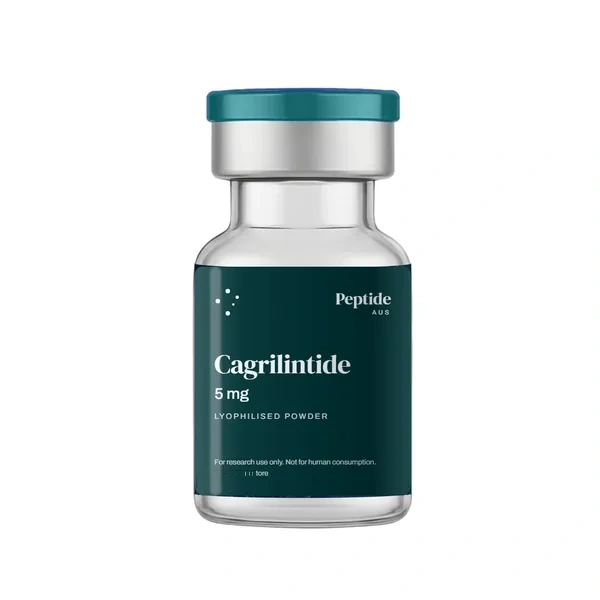
Vial sizes and prices
| Product | Price | Per mg | Stock |
|---|---|---|---|
| Cagrilintide (5mg) | $129.99 | $26.00/mg | In Stock |
| Cagrilintide (10mg) | $229.99 | $23.00/mg | In Stock |

What Cagrilintide is
Long-acting amylin analogue
Cagrilintide is a lipidated version of amylin, the hormone the pancreas releases with insulin to signal fullness to the brainstem. Novo Nordisk built it as a once-weekly compound and is testing it both by itself and in a fixed pairing with semaglutide (CagriSema). For researchers it opens up a way to look at the amylin pathway apart from the incretin pathway.
How it works
Amylin works on calcitonin-receptor complexes partnered with RAMP proteins, which slows gastric emptying and curbs food intake by way of the area postrema. Native amylin clumps together and lasts only minutes; cagrilintide's sequence edits stop it forming fibrils, and a C20 fatty-diacid chain binds albumin to keep it active for roughly a week.
What the research reports
A Phase 2 dose-ranging trial (Lau et al., Lancet 2021) reported average weight reductions reaching 10.8% at 26 weeks with cagrilintide on its own. In Phase 3, the REDEFINE trials of the CagriSema combination reported larger reductions than semaglutide alone. Preclinical work looks at how lean mass is preserved and how the compound interacts with GLP-1 signalling.
Key research areas
- Satiety signalling — Pharmacology of the amylin receptor acting in the area postrema
- Weight regulation — Endpoints from the dose-ranging Phase 2 trial
- Combination research — The added effect seen with GLP-1 agonists in REDEFINE
- Gastric emptying — Scintigraphy endpoints used in mechanistic studies
Also known as: NN9838, AM833, cagri, CagriSema (combination)
Cagrilintide dosage: what the published studies used
The table lists the amount, frequency and duration each Cagrilintide study reports, in the model it used. Most peptide research is animal or cell work, so the model column matters as much as the number. These figures describe the research. They are not a recommendation, and Peptide Aus does not give dosing advice for people.
| Study | Model | Amount used | How often | Duration |
|---|---|---|---|---|
| Lau DCW et al. (2021) | Human, phase 2 RCT, cagrilintide alone (n=906) | 0.3, 0.6, 1.2, 2.4 or 4.5 mg subcutaneous | Once weekly | 26 weeks, including up to 6 weeks escalation |
| Gabe MBN et al. (2024) | Human, thorough QT study, cagrilintide alone (n=105) | Escalated to 4.5 mg subcutaneous | Once weekly | — |
| Nielsen MJF et al. (2026) | Human, phase 1, cagrilintide alone, renal (n=33) and hepatic (n=32) impairment | 0.6 mg (renal study) or 0.9 mg (hepatic study) | Single dose | Assessed to day 36 (renal) or day 39 (hepatic) |
| Enebo LB et al. (2021) | Human, phase 1b RCT, cagrilintide + semaglutide 2.4 mg (n=96) | Cagrilintide 0.16, 0.30, 0.60, 1.2, 2.4 or 4.5 mg with semaglutide 2.4 mg | Once weekly, co-escalated in 4-week intervals | 16 weeks escalation + 4 weeks at target dose |
| Frias JP et al. (2023) | Human, phase 2 RCT, CagriSema vs components, type 2 diabetes (n=92) | Each agent escalated to 2.4 mg | Once weekly | 32 weeks |
| Garvey WT et al. (2025) | Human, phase 3a RCT (REDEFINE 1), CagriSema (n=3417) | Cagrilintide 2.4 mg + semaglutide 2.4 mg; cagrilintide 2.4 mg alone arm | Once weekly | 68 weeks |
| Davies MJ et al. (2025) | Human, phase 3a RCT (REDEFINE 2), CagriSema, type 2 diabetes (n=1206) | Cagrilintide 2.4 mg + semaglutide 2.4 mg | Once weekly | 68 weeks |
| Buse JB et al. (2026) | Human, phase 3 RCT (REIMAGINE 2), CagriSema vs components, type 2 diabetes (n=2713) | 2.4 mg + 2.4 mg or 1.0 mg + 1.0 mg; cagrilintide 2.4 mg alone arm | Once weekly, subcutaneous | 68 weeks |
| Rosenstock J et al. (2026) | Human, phase 3a RCT (REIMAGINE 3), CagriSema with basal insulin (n=274) | 2.4 mg + 2.4 mg or 1.0 mg + 1.0 mg | Once weekly, subcutaneous | 40 weeks |
| Aroda VR et al. (2026) | Human, phase 3a RCT (REIMAGINE 1), CagriSema, type 2 diabetes (n=189) | 2.4 mg + 2.4 mg or 1.0 mg + 1.0 mg | Once weekly, subcutaneous | 40 weeks |
Cagrilintide vial maths
| Vial | Bacteriostatic water | Concentration | Per 0.01 mL (1 unit, U-100) |
|---|---|---|---|
| 5mg | 1 mL | 5 mg/mL | 50 mcg |
| 10mg | 2 mL | 5 mg/mL | 50 mcg |
How to reconstitute Cagrilintide
Cagrilintide ships as a lyophilised (freeze-dried) powder and is reconstituted with bacteriostatic water before laboratory use. Volumes used on this page: 5mg: 1 mL · 10mg: 2 mL.
- Let the vial reach room temperature. Take it out of the freezer about 15 minutes beforehand so condensation doesn't form inside.
- Swab both stoppers. Wipe the Cagrilintide vial and the bacteriostatic water vial with an alcohol swab and let them dry.
- Draw the water. Use a fresh syringe to draw the volume for your vial size from the bacteriostatic water vial.
- Add it slowly down the inside wall. Aim the stream at the glass, not at the powder, so the cake dissolves without foaming.
- Swirl, don't shake. Roll the vial gently between your fingers until the solution is clear. Shaking can damage the peptide.
- Label and refrigerate. Write the date and concentration on the vial and store it at 2–8 °C, protected from light. Never freeze reconstituted solution.
- Work out the concentration. The vial maths table above, or the calculator, converts milligrams and millilitres into mg/mL and syringe units.
Is Cagrilintide legal in Australia?
The Therapeutic Goods Administration (TGA) has not registered cagrilintide as a medicine in Australia, and it holds no approval for human or veterinary use. Peptide Aus provides it as a research reagent for in-vitro laboratory work only. The Poisons Standard and the Therapeutic Goods Act govern the supply of any substance for human use in Australia, and using the material lawfully is down to the buyer. Anyone seeking a treatment should consult a doctor.
Frequently asked questions
What is Cagrilintide?
Long-acting amylin analogue. Cagrilintide is a lipidated version of amylin, the hormone the pancreas releases with insulin to signal fullness to the brainstem. Novo Nordisk built it as a once-weekly compound and is testing it both by itself and in a fixed pairing with semaglutide (CagriSema). For researchers it opens up a way to look at the amylin pathway apart from the incretin pathway.
What is Cagrilintide studied for?
Satiety signalling: pharmacology of the amylin receptor acting in the area postrema. Weight regulation: endpoints from the dose-ranging Phase 2 trial. Combination research: the added effect seen with GLP-1 agonists in REDEFINE. Gastric emptying: scintigraphy endpoints used in mechanistic studies. A Phase 2 dose-ranging trial (Lau et al., Lancet 2021) reported average weight reductions reaching 10.8% at 26 weeks with cagrilintide on its own. In Phase 3, the REDEFINE trials of the CagriSema combination reported larger reductions than semaglutide alone. Preclinical work looks at how lean mass is preserved and how the compound interacts with GLP-1 signalling.
Cagrilintide before and after: what do the studies show?
The Phase 2 dose-ranging trial reported average weight loss of 6.0% to 10.8% at 26 weeks across its doses against 3.0% for placebo, and in REDEFINE-1 the CagriSema combination reported greater reductions than semaglutide alone.
What side effects has Cagrilintide research reported?
Gastrointestinal events, chiefly nausea and vomiting, were the events seen most often in the Phase 2 trial, with injection-site reactions reported as well; most were mild to moderate.
What is the Cagrilintide dosage?
In the published Cagrilintide research, the amounts used were 0.3, 0.6, 1.2, 2.4 or 4.5 mg subcutaneous, Once weekly in human, phase 2 rct, cagrilintide alone (Lau DCW et al. (2021)); Escalated to 4.5 mg subcutaneous, Once weekly in human, thorough qt study, cagrilintide alone (Gabe MBN et al. (2024)); 0.6 mg (renal study) or 0.9 mg (hepatic study), Single dose in human, phase 1, cagrilintide alone, renal and hepatic (n=32) impairment (Nielsen MJF et al. (2026)). These are the figures each study reports for its own model, listed in full in the dosage table on this page with links to PubMed. Peptide Aus supplies Cagrilintide for in-vitro research and does not give dosing guidance for people.
Cagrilintide vs retatrutide: what is the difference?
A different pathway: amylin-receptor agonism as against triple incretin and glucagon agonism. The two are frequently studied together so that satiety signalling can be separated from incretin effects.
Cagrilintide vs tirzepatide: what is the difference?
Tirzepatide is a dual incretin agonist while cagrilintide is an amylin analogue, so the pair is examined as complementary mechanisms rather than rival ones.
Why run cagrilintide next to a GLP-1 compound?
Each pathway curbs food intake through a separate receptor, and the combination trials reported more weight reduction than either compound managed alone. Study designs often line up cagrilintide, a GLP-1 agonist and the two together so the individual contributions can be teased apart.
Should I take 5mg or 10mg?
The 5mg vial is the starting format for assay development, while the 10mg vial cuts the per-milligram price in half for longer protocols.
How do you reconstitute Cagrilintide?
With bacteriostatic water added slowly down the inside wall of the vial, then swirled gently. Each vial size lists its suggested volume, and the calculator converts volume to concentration.
How should Cagrilintide be stored?
Lyophilised: −20 °C, sealed, away from light and moisture. Reconstituted: 2–8 °C, used within 8–12 weeks, never frozen.
Is Cagrilintide legal in Australia?
The Therapeutic Goods Administration (TGA) has not registered cagrilintide as a medicine in Australia, and it holds no approval for human or veterinary use. Peptide Aus provides it as a research reagent for in-vitro laboratory work only. The Poisons Standard and the Therapeutic Goods Act govern the supply of any substance for human use in Australia, and using the material lawfully is down to the buyer. Anyone seeking a treatment should consult a doctor.
Where can I buy Cagrilintide in Australia, and what does it cost?
Directly from Peptide Aus, from Australian stock, in 2 vial sizes from $129.99 (5mg) to $229.99 (10mg). Prices are AUD and GST inclusive. Paid orders before 2pm AEST/AEDT dispatch the same business day, tracked.
How much bacteriostatic water do you add to Cagrilintide?
It depends on the vial size: 5mg takes 1 mL, 10mg takes 2 mL. That gives 5 mg/mL, 5 mg/mL respectively. The reconstitution steps on this page and the calculator cover the rest.
All Cagrilintide products are supplied for in-vitro research and laboratory use only. Not for human or veterinary use.