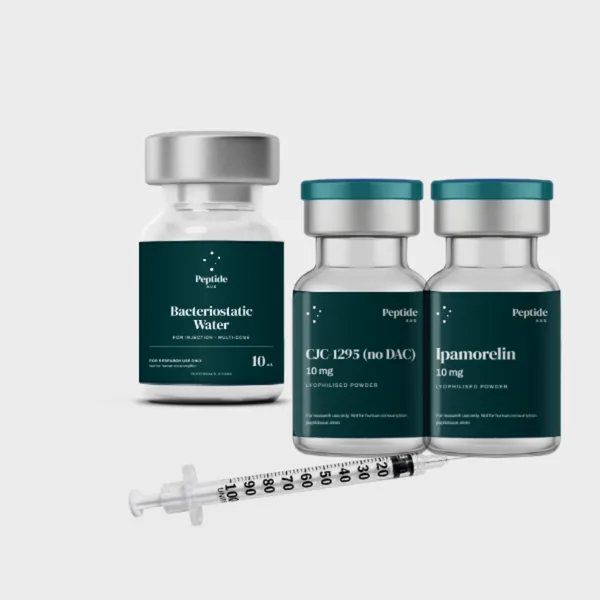
CJC-1295 (no DAC) + Ipamorelin Kit
CJC-1295 (no DAC) and Ipamorelin as separate vials, with water, forty syringes and swabs.
$225.99


Research CJC-1295 (no DAC) vial, dispatched from Australian stock. In Stock
Known more often as Mod GRF 1-29, CJC-1295 without DAC is the opening 29 amino acids of growth-hormone-releasing hormone carrying four substitutions that guard it against degradation. With a half-life near 30 minutes, it throws a short, well-defined GH pulse that looks more like the body's own secretion than a drawn-out rise.
It docks onto the GHRH receptor on somatotrophs. Swapping residues at positions 2, 8, 15 and 27 makes it resistant to DPP-IV cleavage and steadier overall, yet without the albumin-binding DAC group the activity remains short-lived.
Research designs that call for a pulsatile GHRH signal use Mod GRF 1-29, frequently alongside a ghrelin-receptor agonist. The published record is mostly pharmacological characterisation, and no registered product exists.
Also known as: Mod GRF 1-29, Modified GRF (1-29), CJC-1295 without DAC, mod grf 1-29, modified grf
Certificate of analysis. Every batch carries a certificate from an independent laboratory. Request the certificate for your batch with your order number and we send it.
The table lists the amount, frequency and duration each CJC-1295 (no DAC) study reports, in the model it used. Most peptide research is animal or cell work, so the model column matters as much as the number. These figures describe the research. They are not a recommendation, and Peptide Aus does not give dosing advice for people.
| Study | Model | Amount used | How often | Duration |
|---|---|---|---|---|
| Teichman SL et al. (2006) | Human, healthy adults 21-61, randomised placebo-controlled (CJC-1295 WITH DAC) | Four ascending single s.c. doses; 30 and 60 micrograms/kg named as better tolerated | Single dose, or two or three weekly or fortnightly doses | 28 and 49 days |
| Ionescu M et al. (2006) | Human, healthy men 20-40 (CJC-1295 WITH DAC) | 60 or 90 micrograms/kg | Single injection | 1 week follow-up |
| Vial | Bacteriostatic water | Concentration | Per 0.01 mL (1 unit, U-100) |
|---|---|---|---|
| 10mg | 2 mL | 5 mg/mL | 50 mcg |
CJC-1295 (no DAC) ships as a lyophilised (freeze-dried) powder and is reconstituted with bacteriostatic water before laboratory use. Volumes used on this page: 10mg: 2 mL.
For in-vitro research and laboratory use only. Not for human or veterinary use. By purchasing you confirm you are a qualified researcher and will use this compound in accordance with all applicable laws.
Modified GHRH (1-29) analogue without drug-affinity complex. Known more often as Mod GRF 1-29, CJC-1295 without DAC is the opening 29 amino acids of growth-hormone-releasing hormone carrying four substitutions that guard it against degradation. With a half-life near 30 minutes, it throws a short, well-defined GH pulse that looks more like the body's own secretion than a drawn-out rise.
GHRH receptor pharmacology: amplitude and duration of the pulse. Pulsatile versus sustained GH release: set against the DAC form. Combination studies: alongside ipamorelin and other GHRPs. Research designs that call for a pulsatile GHRH signal use Mod GRF 1-29, frequently alongside a ghrelin-receptor agonist. The published record is mostly pharmacological characterisation, and no registered product exists.
The pharmacology data point to a brief, pulsatile GH release lasting under an hour, and pairing it with a GHRP makes the pulse bigger. There are no outcome trials.
GHRH-analogue studies note flushing, headache and injection-site reactions. Its short half-life keeps IGF-1 from staying elevated.
In the published CJC-1295 (no DAC) research, the amounts used were Four ascending single s.c. doses; 30 and 60 micrograms/kg named as better tolerated, Single dose, or two or three weekly or fortnightly doses in human, healthy adults 21-61, randomised placebo-controlled (cjc-1295 with dac) (Teichman SL et al. (2006)); 60 or 90 micrograms/kg, Single injection in human, healthy men 20-40 (cjc-1295 with dac) (Ionescu M et al. (2006)). These are the figures each study reports for its own model, listed in full in the dosage table on this page with links to PubMed. Peptide Aus supplies CJC-1295 (no DAC) for in-vitro research and does not give dosing guidance for people.
Adding DAC stretches the half-life from roughly 30 minutes out to about a week, turning a pulsatile release into a sustained one.
Think of Mod GRF 1-29 as sermorelin fitted with four stabilising substitutions.
Add about 2 mL of bacteriostatic water slowly down the inside of the vial and swirl gently; do not shake. 10mg in 2 mL gives 5 mg/mL. Refrigerate at 2–8 °C after reconstitution and use within 8–12 weeks. The calculator has this vial preset.
Lyophilised: −20 °C, sealed, away from light and moisture. Reconstituted: 2–8 °C, used within 8–12 weeks, never frozen.
The Therapeutic Goods Administration (TGA) has not registered CJC-1295 (no DAC) as a medicine in Australia, and it carries no approval for use in humans or animals. What Peptide Aus sells is a research reagent intended for in-vitro laboratory work and nothing more. In Australia, supplying any substance for human use falls under the Therapeutic Goods Act and the Poisons Standard, and it is the purchaser who must ensure the material is used within the law. Anyone seeking treatment should consult a doctor.
Directly from Peptide Aus, from Australian stock: CJC-1295 (no DAC) (10mg) is $104.99 AUD including GST. Paid orders before 2pm AEST/AEDT dispatch the same business day, tracked.
CJC-1295 (no DAC) and Ipamorelin as separate vials, with water, forty syringes and swabs.
CJC-1295 (no DAC) and Ipamorelin as separate vials, with water, forty syringes and swabs.

Pre-blended GHRH analogue and ghrelin-receptor agonist (5mg + 5mg)

