
Mitochondrial Research
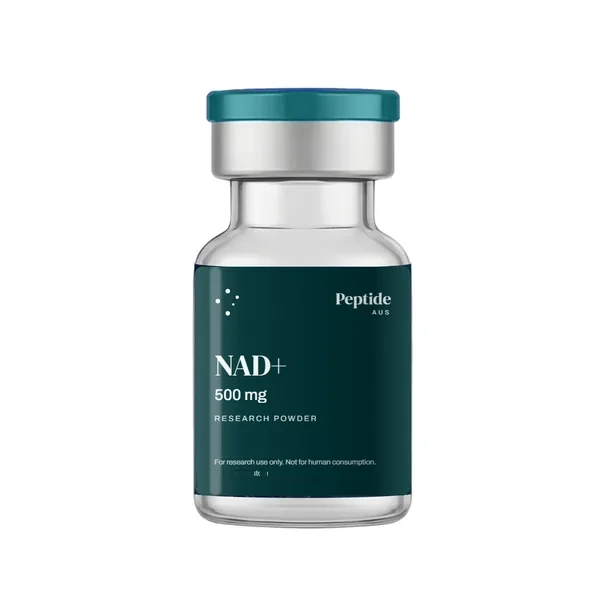
NAD+ (500mg)
Research NAD+ vial, dispatched from Australian stock. In Stock
$129.99AUD, GST inclusive · $0.26 per mg
CoA on request500mg per vialPowderSame business day dispatch*
Nicotinamide adenine dinucleotide, oxidised form
NAD+ is the coenzyme that ferries electrons through cellular respiration and also acts as the substrate for sirtuins, PARPs and CD38. Because its levels in tissue fall as we age, it and its precursors have become a focus of longevity research. In research grade, NAD+ features in enzyme assays and redox studies.
How it works
During glycolysis and the citric-acid cycle NAD+ takes on electrons and turns into NADH, which then hands them to complex I. On a separate track, sirtuins draw on NAD+ to deacetylate proteins tied to stress resistance and mitochondrial biogenesis, while PARPs draw on it during the repair of DNA.
What the research reports
Rodent experiments that restore NAD+ by way of precursors such as NMN and NR report improvements in mitochondrial function and metabolic markers with age. In humans, precursor trials consistently raise blood NAD+ while producing only modest functional endpoints. Clinics study NAD+ given directly for an assortment of unproven indications.
Key research areas
- Sirtuin activity — Deacetylation that depends on NAD+
- DNA repair — Availability of substrate for PARP
- Mitochondrial respiration — The ratio of NAD+ to NADH
- Ageing biology — The decline in NAD+ that comes with age
Also known as: NAD, Beta-nicotinamide adenine dinucleotide, Coenzyme 1, nad, nad+ 500mg, nicotinamide adenine dinucleotide
Certificate of analysis. Every batch carries a certificate from an independent laboratory. Request the certificate for your batch with your order number and we send it.
Specifications
- Compound
- NAD+
- CAS number
- 53-84-9
- Category
- Mitochondrial Research
- Vial size
- 500mg
- Certificate of analysis
- Available on request
- Form
- Powder
- Suggested reconstitution
- 5 mL bacteriostatic water
- Storage (lyophilised)
- −20 °C, protect from light and moisture
- Storage (reconstituted)
- 2–8 °C, use within 8–12 weeks
- SKU
- SUP-002-500MG
Reconstitution calculator for this vial
Full calculator →NAD+ dosage: what the published studies used
The table lists the amount, frequency and duration each NAD+ study reports, in the model it used. Most peptide research is animal or cell work, so the model column matters as much as the number. These figures describe the research. They are not a recommendation, and Peptide Aus does not give dosing advice for people.
| Study | Model | Amount used | How often | Duration |
|---|---|---|---|---|
| Pencina KM et al. (2023) | Human RCT, n=30; oral NMN tablets | Two 500 mg NMN tablets | Twice daily | 28 days |
| Brakedal B et al. (2022) | Human phase I RCT, n=30; oral NR | 1,000 mg NR | — | 30 days |
| Elhassan YS et al. (2019) | Human crossover RCT, n=12; oral NR | 1 g NR | Per day | 21 days |
| Vreones M et al. (2023) | Human crossover RCT, n=22; oral NR | 500 mg NR | Twice a day | 6 weeks |
| Katayoshi T et al. (2023) | Human RCT, n=36; oral NMN capsules | 125 mg NMN (250 mg/day) | Twice a day | 12 weeks |
| Castro-Marrero J et al. (2021) | Human RCT, n=207; oral NADH with CoQ10 | 20 mg NADH plus 200 mg CoQ10 | Once daily | 12 weeks |
| Li X et al. (2023) | Human controlled trial; oral NAD+ precursors within combined metabolic activators | 1 g of the NAD+ precursor | Single day | 1 day |
NAD+ vial maths
| Vial | Bacteriostatic water | Concentration | Per 0.01 mL (1 unit, U-100) |
|---|---|---|---|
| 500mg | 5 mL | 100 mg/mL | 1000 mcg |
How to reconstitute NAD+
NAD+ ships as a lyophilised (freeze-dried) powder and is reconstituted with bacteriostatic water before laboratory use. Volumes used on this page: 500mg: 5 mL.
- Let the vial reach room temperature. Take it out of the freezer about 15 minutes beforehand so condensation doesn't form inside.
- Swab both stoppers. Wipe the NAD+ vial and the bacteriostatic water vial with an alcohol swab and let them dry.
- Draw the water. Use a fresh syringe to draw the volume for your vial size from the bacteriostatic water vial.
- Add it slowly down the inside wall. Aim the stream at the glass, not at the powder, so the cake dissolves without foaming.
- Swirl, don't shake. Roll the vial gently between your fingers until the solution is clear. Shaking can damage the peptide.
- Label and refrigerate. Write the date and concentration on the vial and store it at 2–8 °C, protected from light. Never freeze reconstituted solution.
- Work out the concentration. The vial maths table above, or the calculator, converts milligrams and millilitres into mg/mL and syringe units.
For in-vitro research and laboratory use only. Not for human or veterinary use. By purchasing you confirm you are a qualified researcher and will use this compound in accordance with all applicable laws.
Frequently asked questions
What is NAD+?
Nicotinamide adenine dinucleotide, oxidised form. NAD+ is the coenzyme that ferries electrons through cellular respiration and also acts as the substrate for sirtuins, PARPs and CD38. Because its levels in tissue fall as we age, it and its precursors have become a focus of longevity research. In research grade, NAD+ features in enzyme assays and redox studies.
What is NAD+ studied for?
Sirtuin activity: deacetylation that depends on NAD+. DNA repair: availability of substrate for PARP. Mitochondrial respiration: the ratio of NAD+ to NADH. Ageing biology: the decline in NAD+ that comes with age. Rodent experiments that restore NAD+ by way of precursors such as NMN and NR report improvements in mitochondrial function and metabolic markers with age. In humans, precursor trials consistently raise blood NAD+ while producing only modest functional endpoints. Clinics study NAD+ given directly for an assortment of unproven indications.
NAD+ before and after: what do the studies show?
In humans, trials of NAD+ precursors dependably lifted blood NAD+ while changing functional endpoints only modestly; in rodents, NAD+ restoration reported better mitochondrial function with age. Direct NAD+ administration is under clinical study for unproven indications.
What side effects has NAD+ research reported?
Given intravenously in clinics, NAD+ is linked to flushing, nausea and chest tightness during the infusion. The research powder is meant for laboratory use.
What is the NAD+ dosage?
In the published NAD+ research, the amounts used were Two 500 mg NMN tablets, Twice daily in human rct, n=30; oral nmn tablets (Pencina KM et al. (2023)); 1,000 mg NR in human phase i rct, n=30; oral nr (Brakedal B et al. (2022)); 1 g NR, Per day in human crossover rct, n=12; oral nr (Elhassan YS et al. (2019)). These are the figures each study reports for its own model, listed in full in the dosage table on this page with links to PubMed. Peptide Aus supplies NAD+ for in-vitro research and does not give dosing guidance for people.
NAD+ injections, IV drips or pens?
Outside research supply, clinics provide NAD+ infusions and injections, and the so-called 'NAD+ pens' are unregulated devices. What Peptide Aus offers is research-grade NAD+ powder in a 500mg vial for laboratory use.
NAD+ vs NMN: what is the difference?
Cells convert the precursors NMN and NR into NAD+, whereas NAD+ is already the finished coenzyme.
NAD+ vs glutathione: what is the difference?
Their roles differ: NAD+ carries electrons and supplies sirtuins, while glutathione buffers oxidation.
What is the reason for a 500mg vial?
Unlike the microgram quantities of signalling peptides, NAD+ is handled at the milligram-to-gram scale, so it calls for a bigger reconstitution volume of roughly 5 mL.
How do you reconstitute NAD+ (500mg)?
Add about 5 mL of bacteriostatic water slowly down the inside of the vial and swirl gently; do not shake. 500mg in 5 mL gives 100 mg/mL. Refrigerate at 2–8 °C after reconstitution and use within 8–12 weeks. The calculator has this vial preset.
How should NAD+ be stored?
Lyophilised: −20 °C, sealed, away from light and moisture. Reconstituted: 2–8 °C, used within 8–12 weeks, never frozen.
Is NAD+ legal in Australia?
In Australia, NAD+ holds no Therapeutic Goods Administration (TGA) registration as a medicine and carries no approval for use in humans or animals. The material is offered by Peptide Aus strictly as a research reagent intended for in-vitro laboratory work. The Poisons Standard and the Therapeutic Goods Act set the rules for supplying any substance for human use in this country, and lawful use of the material rests with the buyer. Anyone seeking treatment should consult a doctor.
Where can I buy NAD+ in Australia, and what does it cost?
Directly from Peptide Aus, from Australian stock: NAD+ (500mg) is $129.99 AUD including GST. Paid orders before 2pm AEST/AEDT dispatch the same business day, tracked.
Kits with this compound
Frequently bought together