
Tirzepatide in Australia
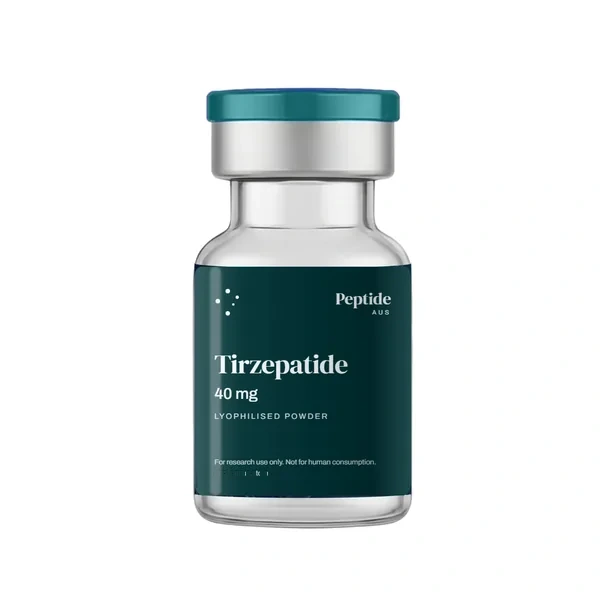
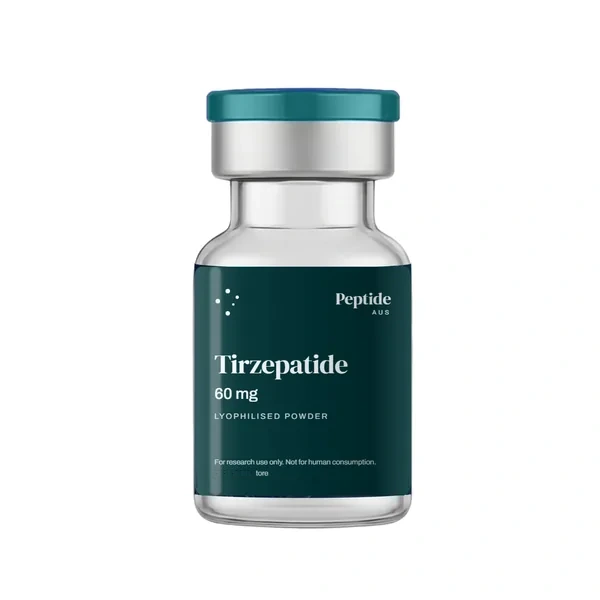
Tirzepatide is available in Australia as a research-grade lyophilised vial for laboratory use, in 3 sizes from $249.99 (20mg) to $349.99 (60mg), shipped from Peptide Aus stock. It is not approved for human use.
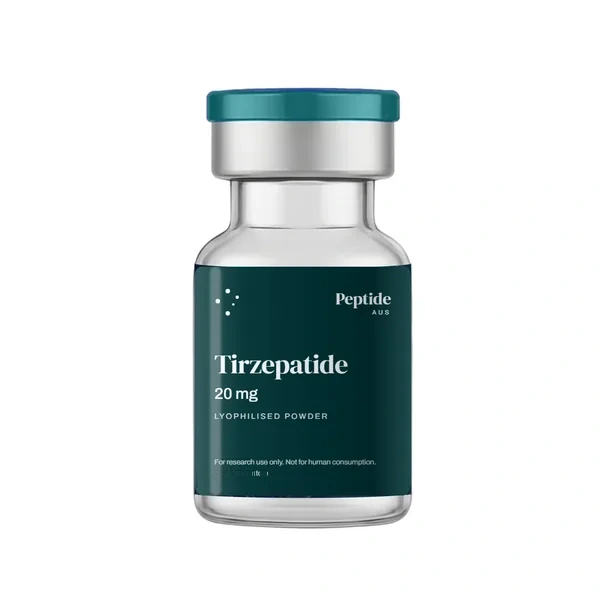
Vial sizes and prices
| Product | Price | Per mg | Stock |
|---|---|---|---|
| Tirzepatide (20mg) | $249.99 | $12.50/mg | In Stock |
| Tirzepatide (40mg) | $279.99 | $7.00/mg | In Stock |
| Tirzepatide (60mg) | $349.99 | $5.83/mg | In Stock |
What Tirzepatide is
Dual GIP and GLP-1 receptor agonist
Tirzepatide is a peptide of 39 amino acids that switches on both the GIP and the GLP-1 receptor. As the first dual incretin agonist to finish Phase 3 development, it is now registered as a prescription medicine across many countries. The research-grade vial offered here is the unformulated peptide intended for laboratory use, not the branded pen.
How it works
The molecule starts from the GIP backbone, adds changes that give it GLP-1 receptor affinity, and attaches a fatty-acid side chain that binds albumin to stretch the half-life out to roughly five days. Pharmacology studies suggest the GIP element reinforces the appetite and glucose effects driven by GLP-1 while helping adipose tissue manage lipids.
What the research reports
In type 2 diabetes the SURPASS trials and in obesity the SURMOUNT trials reported HbA1c drops of about 2 percentage points and average weight reductions reaching 22.5% at the top dose across 72 weeks (SURMOUNT-1, Jastreboff et al., NEJM 2022). Studies that followed looked at sleep apnoea, heart failure with preserved ejection fraction and MASLD.
Key research areas
- Glycaemic control — Fasting glucose and HbA1c tracked throughout the SURPASS trials
- Body composition — DEXA sub-studies separating fat mass from lean mass
- Appetite signalling — Satiety and food-intake measures taken in Phase 1 pharmacology
- Hepatic fat — Liver-fat fraction read by MRI-PDFF in the MASLD studies
- Cardiovascular outcomes — The SURPASS-CVOT and SUMMIT programs
Also known as: LY3298176, Tirz, tirz, tirzeptide, Mounjaro (brand), Zepbound (brand)
Tirzepatide dosage: what the published studies used
The table lists the amount, frequency and duration each Tirzepatide study reports, in the model it used. Most peptide research is animal or cell work, so the model column matters as much as the number. These figures describe the research. They are not a recommendation, and Peptide Aus does not give dosing advice for people.
| Study | Model | Amount used | How often | Duration |
|---|---|---|---|---|
| Rosenstock J et al. (2021) | Human, phase 3, type 2 diabetes (n=478) | 5, 10 or 15 mg | Once weekly | 40 weeks |
| Ludvik B et al. (2021) | Human, phase 3, type 2 diabetes on metformin (n=1444) | 5, 10 or 15 mg, started at 2.5 mg and raised by 2.5 mg every 4 weeks | Once weekly, subcutaneous | 52 weeks |
| Dahl D et al. (2022) | Human, phase 3, type 2 diabetes on insulin glargine (n=475) | 5, 10 or 15 mg, started at 2.5 mg and raised by 2.5 mg every 4 weeks | Once weekly, subcutaneous | 40 weeks |
| Jastreboff AM et al. (2022) | Human, phase 3, obesity (n=2539) | 5, 10 or 15 mg | Once weekly, subcutaneous | 72 weeks, including 20-week escalation |
| Aronne LJ et al. (2024) | Human, phase 3 withdrawal trial, obesity (n=783 in lead-in) | Maximum tolerated dose, 10 or 15 mg | Once weekly, subcutaneous | 36-week lead-in plus 52 weeks |
| Malhotra A et al. (2024) | Human, phase 3, obstructive sleep apnoea with obesity | Maximum tolerated dose, 10 or 15 mg | — | 52 weeks |
| Packer M et al. (2025) | Human, HFpEF with obesity (n=731) | Up to 15 mg | Once weekly, subcutaneous | At least 52 weeks |
| Heise T et al. (2022) | Human, phase 1 mechanistic trial, type 2 diabetes (n=117) | 15 mg | Once weekly, subcutaneous | 28 weeks |
| Hannon TS et al. (2025) | Human, phase 3, youth-onset type 2 diabetes aged 10 to <18 (n=99) | 5 or 10 mg, by single-dose pen | — | 30 weeks, then 22-week open-label extension |
Tirzepatide vial maths
| Vial | Bacteriostatic water | Concentration | Per 0.01 mL (1 unit, U-100) |
|---|---|---|---|
| 20mg | 2 mL | 10 mg/mL | 100 mcg |
| 40mg | 2 mL | 20 mg/mL | 200 mcg |
| 60mg | 3 mL | 20 mg/mL | 200 mcg |
How to reconstitute Tirzepatide
Tirzepatide ships as a lyophilised (freeze-dried) powder and is reconstituted with bacteriostatic water before laboratory use. Volumes used on this page: 20mg: 2 mL · 40mg: 2 mL · 60mg: 3 mL.
- Let the vial reach room temperature. Take it out of the freezer about 15 minutes beforehand so condensation doesn't form inside.
- Swab both stoppers. Wipe the Tirzepatide vial and the bacteriostatic water vial with an alcohol swab and let them dry.
- Draw the water. Use a fresh syringe to draw the volume for your vial size from the bacteriostatic water vial.
- Add it slowly down the inside wall. Aim the stream at the glass, not at the powder, so the cake dissolves without foaming.
- Swirl, don't shake. Roll the vial gently between your fingers until the solution is clear. Shaking can damage the peptide.
- Label and refrigerate. Write the date and concentration on the vial and store it at 2–8 °C, protected from light. Never freeze reconstituted solution.
- Work out the concentration. The vial maths table above, or the calculator, converts milligrams and millilitres into mg/mL and syringe units.
Is Tirzepatide legal in Australia?
Supplied as the registered product, tirzepatide is a Schedule 4 prescription-only medicine in Australia. Research-grade tirzepatide powder is a different thing altogether and has no approval for human use. Peptide Aus provides it only for in-vitro laboratory research.
Frequently asked questions
What is Tirzepatide?
Dual GIP and GLP-1 receptor agonist. Tirzepatide is a peptide of 39 amino acids that switches on both the GIP and the GLP-1 receptor. As the first dual incretin agonist to finish Phase 3 development, it is now registered as a prescription medicine across many countries. The research-grade vial offered here is the unformulated peptide intended for laboratory use, not the branded pen.
What is Tirzepatide studied for?
Glycaemic control: fasting glucose and HbA1c tracked throughout the SURPASS trials. Body composition: dEXA sub-studies separating fat mass from lean mass. Appetite signalling: satiety and food-intake measures taken in Phase 1 pharmacology. Hepatic fat: liver-fat fraction read by MRI-PDFF in the MASLD studies. Cardiovascular outcomes: the SURPASS-CVOT and SUMMIT programs. In type 2 diabetes the SURPASS trials and in obesity the SURMOUNT trials reported HbA1c drops of about 2 percentage points and average weight reductions reaching 22.5% at the top dose across 72 weeks (SURMOUNT-1, Jastreboff et al., NEJM 2022). Studies that followed looked at sleep apnoea, heart failure with preserved ejection fraction and MASLD.
Tirzepatide before and after: what do the studies show?
SURMOUNT-1 recorded average weight reductions of 15.0%, 19.5% and 20.9% at 5, 10 and 15mg weekly over 72 weeks (22.5% on the treatment-regimen estimand) against 3.1% for placebo, and the SURPASS trials reported HbA1c reductions near 2 percentage points. Body-composition sub-studies traced about three quarters of the weight lost to fat mass.
What side effects has Tirzepatide research reported?
The trials saw gastrointestinal events most often, namely nausea, diarrhoea, reduced appetite, vomiting and constipation, usually mild to moderate and arising while the dose was being escalated. Labelling for the registered product flags pancreatitis, gallbladder disease, hypoglycaemia when combined with insulin secretagogues, and a boxed warning on thyroid C-cell tumours drawn from rodent findings.
What is the Tirzepatide dosage?
In the published Tirzepatide research, the amounts used were 5, 10 or 15 mg, Once weekly in human, phase 3, type 2 diabetes (Rosenstock J et al. (2021)); 5, 10 or 15 mg, started at 2.5 mg and raised by 2.5 mg every 4 weeks, Once weekly, subcutaneous in human, phase 3, type 2 diabetes on metformin (Ludvik B et al. (2021)); 5, 10 or 15 mg, started at 2.5 mg and raised by 2.5 mg every 4 weeks, Once weekly, subcutaneous in human, phase 3, type 2 diabetes on insulin glargine (Dahl D et al. (2022)). These are the figures each study reports for its own model, listed in full in the dosage table on this page with links to PubMed. Peptide Aus supplies Tirzepatide for in-vitro research and does not give dosing guidance for people.
Tirzepatide vs retatrutide: what is the difference?
Retatrutide layers glucagon receptor activity over the GLP-1 and GIP profile of tirzepatide and reported bigger weight loss in its Phase 2 trial; tirzepatide, however, is the one approved as a medicine.
Tirzepatide vs semaglutide: what is the difference?
The two met head-to-head in SURPASS-2 in type 2 diabetes, where tirzepatide beat semaglutide 1mg on both HbA1c and weight at each of its three doses.
Tirzepatide vs Mounjaro: what is the difference?
Mounjaro is the registered tirzepatide pen for prescription use. The research vial holds the same peptide as unformulated lyophilised powder for laboratory work and does not stand in for it.
Is this the same thing as Mounjaro or Zepbound?
The active peptide is the same, but the product is not. Mounjaro is a registered, sterile, dose-metered injection made under pharmaceutical GMP for use on prescription. What you see here is unformulated research-grade tirzepatide for laboratory study, and it is not a replacement for a prescribed medicine.
Which vial size fits a research plan?
Pick the 20mg vial for short assays and method development. The 40mg and 60mg vials cut down on how often you reconstitute over a longer protocol and work out cheaper per milligram. Every size ships with its own certificate of analysis.
How do you reconstitute Tirzepatide?
With bacteriostatic water added slowly down the inside wall of the vial, then swirled gently. Each vial size lists its suggested volume, and the calculator converts volume to concentration.
How should Tirzepatide be stored?
Lyophilised: −20 °C, sealed, away from light and moisture. Reconstituted: 2–8 °C, used within 8–12 weeks, never frozen.
Is Tirzepatide legal in Australia?
Supplied as the registered product, tirzepatide is a Schedule 4 prescription-only medicine in Australia. Research-grade tirzepatide powder is a different thing altogether and has no approval for human use. Peptide Aus provides it only for in-vitro laboratory research.
Where can I buy Tirzepatide in Australia, and what does it cost?
Directly from Peptide Aus, from Australian stock, in 3 vial sizes from $249.99 (20mg) to $349.99 (60mg). Prices are AUD and GST inclusive. Paid orders before 2pm AEST/AEDT dispatch the same business day, tracked.
How much bacteriostatic water do you add to Tirzepatide?
It depends on the vial size: 20mg takes 2 mL, 40mg takes 2 mL, 60mg takes 3 mL. That gives 10 mg/mL, 20 mg/mL, 20 mg/mL respectively. The reconstitution steps on this page and the calculator cover the rest.
All Tirzepatide products are supplied for in-vitro research and laboratory use only. Not for human or veterinary use.