
Build-Your-Own GLOW
GHK-Cu 50mg plus the BPC-157 + TB-500 blend, with water, forty syringes and swabs: GLOW's components as separate vials.
$240.99


Research BPC-157 + TB-500 vial, dispatched from Australian stock. In Stock
This vial puts BPC-157 and TB-500 together in one lyophilised blend, letting both be reconstituted and worked with as a single solution. The pair is the most common pairing in tissue-repair research precisely because their reported mechanisms sit apart: one works on growth-factor and nitric-oxide signalling, the other on the actin cytoskeleton.
BPC-157 brings angiogenic and anti-inflammatory signalling to the injury site, while TB-500 brings cell migration and cytoskeletal remodelling. A single blended vial takes out the variability of combining two separately reconstituted solutions and holds the ratio steady across a protocol.
The blend has not been evaluated as a single product in any controlled study. Its rationale rests on the separate bodies of work for each peptide, covered on their own pages. Anyone comparing the pair with either compound alone should note that the blend locks the ratio at 1:1 by mass.
Also known as: BPC/TB blend, BPC-157 TB-500 stack, wolverine stack, bpc tb500 blend
Certificate of analysis. Every batch carries a certificate from an independent laboratory. Request the certificate for your batch with your order number and we send it.
The table lists the amount, frequency and duration each BPC-157 + TB-500 study reports, in the model it used. Most peptide research is animal or cell work, so the model column matters as much as the number. These figures describe the research. They are not a recommendation, and Peptide Aus does not give dosing advice for people.
| Study | Model | Amount used | How often | Duration |
|---|---|---|---|---|
| Lee E et al. (2024) | Human pilot, interstitial cystitis (n=12), BPC-157 | 10 mg total, injection around the inflamed bladder area | Once, during a single procedure | — |
| Lee E et al. (2025) | Human safety pilot (n=2), BPC-157 | 10 mg IV (day 1), 20 mg IV (day 2), each in 250 cc saline over 1 h | Once daily on 2 days | 3 days |
| Perovic D et al. (2019) | Rat, spinal cord injury, BPC-157 | 200 or 2 μg/kg intraperitoneal | Once, 10 min after injury | Followed to 360 days |
| Vial | Bacteriostatic water | Concentration | Per 0.01 mL (1 unit, U-100) |
|---|---|---|---|
| 10mg | 2 mL | 5 mg/mL | 50 mcg |
BPC-157 + TB-500 ships as a lyophilised (freeze-dried) powder and is reconstituted with bacteriostatic water before laboratory use. Volumes used on this page: 10mg: 2 mL.
For in-vitro research and laboratory use only. Not for human or veterinary use. By purchasing you confirm you are a qualified researcher and will use this compound in accordance with all applicable laws.
Pre-blended tissue-repair research pair (5mg + 5mg). This vial puts BPC-157 and TB-500 together in one lyophilised blend, letting both be reconstituted and worked with as a single solution. The pair is the most common pairing in tissue-repair research precisely because their reported mechanisms sit apart: one works on growth-factor and nitric-oxide signalling, the other on the actin cytoskeleton.
Combined repair models: tendon, ligament and muscle injury protocols that use both agents. Mechanism comparison: teasing apart growth-factor from cytoskeletal contributions. Handling: one reconstitution for two-compound designs. The blend has not been evaluated as a single product in any controlled study. Its rationale rests on the separate bodies of work for each peptide, covered on their own pages. Anyone comparing the pair with either compound alone should note that the blend locks the ratio at 1:1 by mass.
No trial has evaluated the pair as one product; the component evidence lives on each compound's page. The combination is picked because the two mechanisms do not overlap.
There are no combined safety data. Each compound's own profile applies, and WADA prohibits both.
In the published BPC-157 + TB-500 research, the amounts used were 10 mg total, injection around the inflamed bladder area, Once, during a single procedure in human pilot, interstitial cystitis, bpc-157 (Lee E et al. (2024)); 10 mg IV (day 1), 20 mg IV (day 2), each in 250 cc saline over 1 h, Once daily on 2 days in human safety pilot, bpc-157 (Lee E et al. (2025)); 200 or 2 μg/kg intraperitoneal, Once, 10 min after injury in rat, spinal cord injury, bpc-157 (Perovic D et al. (2019)). These are the figures each study reports for its own model, listed in full in the dosage table on this page with links to PubMed. Peptide Aus supplies BPC-157 + TB-500 for in-vitro research and does not give dosing guidance for people.
Pick the single vial when the research question isolates growth-factor signalling.
Pick the single vial when the question isolates cell migration.
5mg of BPC-157 with 5mg of TB-500, for 10mg total per vial, as confirmed on the batch certificate.
Yes. Both BPC-157 (10mg) and TB-500 (10mg) are stocked as single-compound vials if your design calls for a different ratio.
Add about 2 mL of bacteriostatic water slowly down the inside of the vial and swirl gently; do not shake. 10mg in 2 mL gives 5 mg/mL. Refrigerate at 2–8 °C after reconstitution and use within 8–12 weeks. The calculator has this vial preset.
Lyophilised: −20 °C, sealed, away from light and moisture. Reconstituted: 2–8 °C, used within 8–12 weeks, never frozen.
The Therapeutic Goods Administration (TGA) has not registered BPC-157 + TB-500 as a medicine in Australia, and it is not approved for human or veterinary use. Peptide Aus supplies it only as a research reagent for in-vitro laboratory work. The supply of any substance for human use in Australia is governed by the Poisons Standard and the Therapeutic Goods Act, and lawful use remains the buyer's responsibility. If a treatment is what you need, see a doctor.
Directly from Peptide Aus, from Australian stock: BPC-157 + TB-500 (10mg) is $109.99 AUD including GST. Paid orders before 2pm AEST/AEDT dispatch the same business day, tracked.
GHK-Cu 50mg plus the BPC-157 + TB-500 blend, with water, forty syringes and swabs: GLOW's components as separate vials.


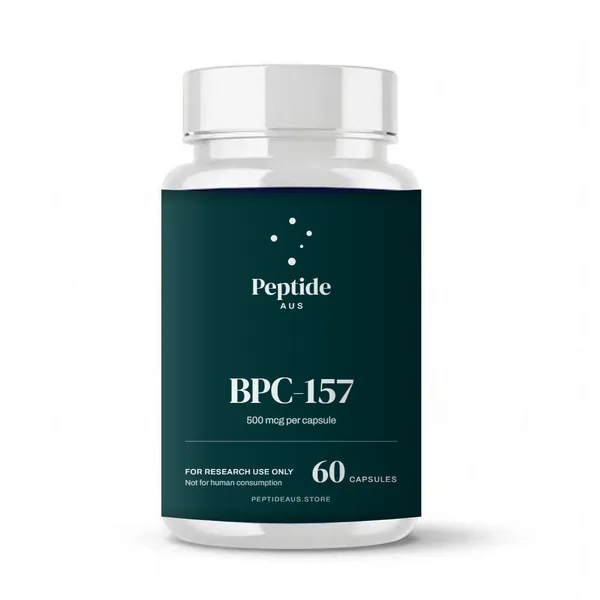
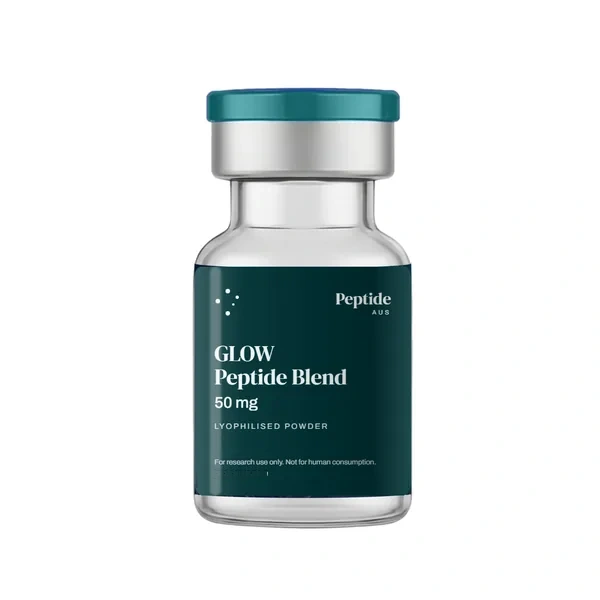
Pre-blended GHK-Cu, BPC-157 and TB-500 for skin and repair research