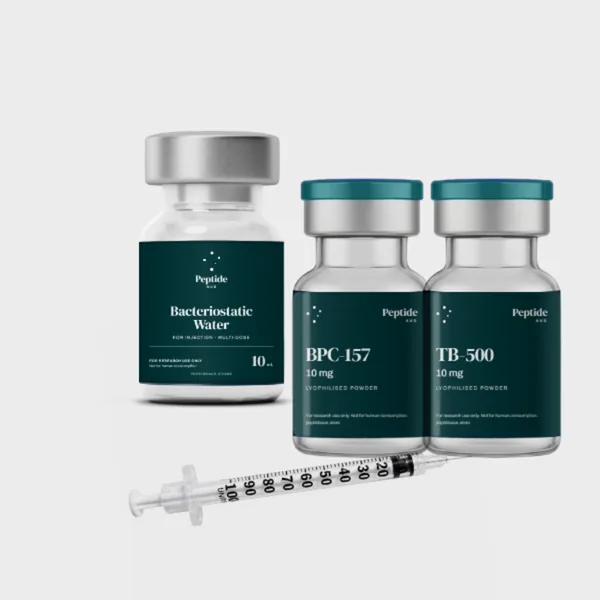
Tissue Repair Pair (BPC-157 + TB-500)
BPC-157 and TB-500 as separate 10mg vials with water, forty syringes and swabs.
$255.99


Research BPC-157 vial, dispatched from Australian stock. In Stock
A stable sequence of 15 amino acids lifted from a protective protein in human gastric juice, BPC-157 ranks among the most heavily cited repair peptides in the preclinical record. Several hundred rodent experiments have examined it across tendon, ligament, muscle, gut and nervous-system injury. Part of what sets it apart is its durability: it withstands stomach acid and stays active in solution for days.
Reported activity converges on the nitric-oxide system, the upregulation of growth-factor receptors (notably VEGFR2 and the EGR-1 pathway), and changes to the FAK-paxillin signalling that fibroblasts rely on to migrate and adhere. In injury models the visible result is quicker angiogenesis, better-organised collagen and less inflammatory infiltrate.
Accelerated healing against controls has been reported in rat Achilles tendon transection (Staresinic et al., J Orthop Res 2003), medial collateral ligament injury, muscle crush and gastric-ulcer models. Gut work shows the intestinal lining protected in NSAID-induced injury. The human record is thin, limited to small trials and case series, and no controlled human trial exists.
Also known as: Body Protection Compound 157, BPC157, Bepecin, PL 14736, bcp157, bpc 175, body protective compound
Certificate of analysis. Every batch carries a certificate from an independent laboratory. Request the certificate for your batch with your order number and we send it.
The table lists the amount, frequency and duration each BPC-157 study reports, in the model it used. Most peptide research is animal or cell work, so the model column matters as much as the number. These figures describe the research. They are not a recommendation, and Peptide Aus does not give dosing advice for people.
| Study | Model | Amount used | How often | Duration |
|---|---|---|---|---|
| Lee E et al. (2024) | Human pilot, interstitial cystitis (n=12) | 10 mg total, injection around the inflamed bladder area | Once, during a single procedure | — |
| Lee E et al. (2025) | Human safety pilot (n=2) | 10 mg IV (day 1), 20 mg IV (day 2), each in 250 cc saline over 1 h | Once daily on 2 days | 3 days |
| Perovic D et al. (2019) | Rat, spinal cord injury | 200 or 2 μg/kg intraperitoneal | Once, 10 min after injury | Followed to 360 days |
| Duzel A et al. (2017) | Rat, ischaemic colitis | 10 μg/kg bath (1 mL/rat) on the colon segment | — | Up to 10 days |
| Zivanovic-Posilovic G et al. (2016) | Rat, bupivacaine cardiotoxicity | 50 µg/kg, 10 µg/kg, 10 ng/kg or 10 pg/kg intraperitoneal | Once, 30 min before or 1 min after bupivacaine | — |
| Vial | Bacteriostatic water | Concentration | Per 0.01 mL (1 unit, U-100) |
|---|---|---|---|
| 10mg | 2 mL | 5 mg/mL | 50 mcg |
BPC-157 ships as a lyophilised (freeze-dried) powder and is reconstituted with bacteriostatic water before laboratory use. Volumes used on this page: 10mg: 2 mL.
For in-vitro research and laboratory use only. Not for human or veterinary use. By purchasing you confirm you are a qualified researcher and will use this compound in accordance with all applicable laws.
Synthetic pentadecapeptide derived from a gastric protein sequence. A stable sequence of 15 amino acids lifted from a protective protein in human gastric juice, BPC-157 ranks among the most heavily cited repair peptides in the preclinical record. Several hundred rodent experiments have examined it across tendon, ligament, muscle, gut and nervous-system injury. Part of what sets it apart is its durability: it withstands stomach acid and stays active in solution for days.
Tendon and ligament: achilles and MCL transection models with biomechanical endpoints. Skeletal muscle: recovery from crush and denervation injury. Gastrointestinal protection: mucosal injury from NSAIDs and alcohol, plus inflammatory bowel models. Angiogenesis: vessel formation and VEGFR2 signalling at the injury site. Nervous system: models of peripheral nerve and spinal-cord injury. Accelerated healing against controls has been reported in rat Achilles tendon transection (Staresinic et al., J Orthop Res 2003), medial collateral ligament injury, muscle crush and gastric-ulcer models. Gut work shows the intestinal lining protected in NSAID-induced injury. The human record is thin, limited to small trials and case series, and no controlled human trial exists.
In rat tendon-transection work, treated tendons gained biomechanical strength and better-organised collagen inside a few weeks; ligament and muscle-crush models reported quicker functional recovery; gut models reported smaller lesion scores. Human 'before and after' photos form no part of the published record.
No consistent toxicity shows up in the rodent literature, though a controlled human safety study is missing. Reviews flag theoretical issues such as angiogenic activity where tumours are present and the lack of long-term data. WADA prohibits it.
In the published BPC-157 research, the amounts used were 10 mg total, injection around the inflamed bladder area, Once, during a single procedure in human pilot, interstitial cystitis (Lee E et al. (2024)); 10 mg IV (day 1), 20 mg IV (day 2), each in 250 cc saline over 1 h, Once daily on 2 days in human safety pilot (Lee E et al. (2025)); 200 or 2 μg/kg intraperitoneal, Once, 10 min after injury in rat, spinal cord injury (Perovic D et al. (2019)). These are the figures each study reports for its own model, listed in full in the dosage table on this page with links to PubMed. Peptide Aus supplies BPC-157 for in-vitro research and does not give dosing guidance for people.
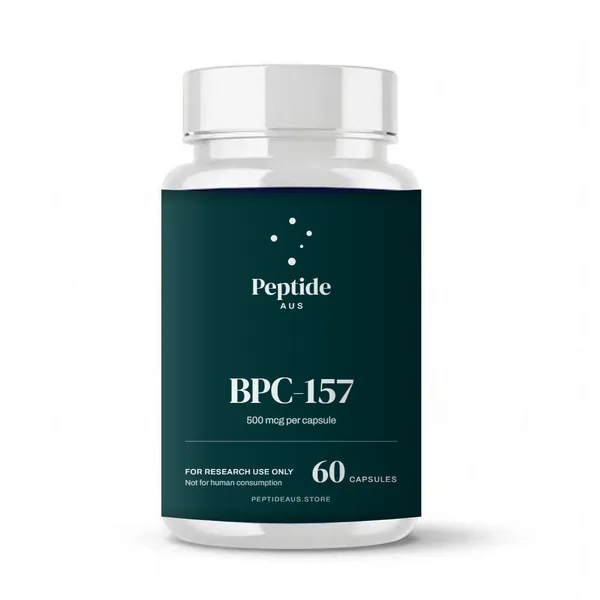
We keep both. The vial matches the format used in the tendon, muscle and nerve studies; the 500 mcg capsules fit oral and gut designs, where the earliest BPC-157 research belongs.
A different route of action: BPC-157 signals through nitric oxide and growth factors, whereas TB-500 works via the actin cytoskeleton and cell migration, which is why researchers frequently pair them.
The 'Wolverine stack' is forum slang for BPC-157 paired with TB-500; Peptide Aus carries that combination as a pre-blended vial.
We stock both. Reconstituted from the 10mg lyophilised vial, the solution fits the systemic, tendon and muscle designs that most of the literature used. The capsules hold 500 mcg of BPC-157 apiece, 60 to a bottle, and are suited to oral and gastrointestinal work where the peptide targets the gut lining. Either format comes with a batch certificate on request.
BPC-157 is the shortest fragment of a parent protein, isolated from human gastric juice, that retains the protein's stomach-lining protection. That is the reason the first studies looked at ulcer models.
It does. In 2022 the World Anti-Doping Agency listed BPC-157 as a non-approved substance on its Prohibited List, which matters for any research that involves athletes.
Add about 2 mL of bacteriostatic water slowly down the inside of the vial and swirl gently; do not shake. 10mg in 2 mL gives 5 mg/mL. Refrigerate at 2–8 °C after reconstitution and use within 8–12 weeks. The calculator has this vial preset.
Lyophilised: −20 °C, sealed, away from light and moisture. Reconstituted: 2–8 °C, used within 8–12 weeks, never frozen.
No registered BPC-157 medicine exists anywhere, and the TGA has not approved the peptide for any human use. Within Australia, supplying it for human use sits under the prescription-only schedule of the Poisons Standard, and the TGA has acted against companies that market it that way. Peptide Aus provides BPC-157 strictly as a research reagent for in-vitro laboratory work, and responsibility for lawful use rests with the buyer. Our guide covers the legal status of BPC-157 in Australia.
Directly from Peptide Aus, from Australian stock: BPC-157 (10mg) is $94.99 AUD including GST. Paid orders before 2pm AEST/AEDT dispatch the same business day, tracked.
BPC-157 and TB-500 as separate 10mg vials with water, forty syringes and swabs.
BPC-157 and TB-500 as separate 10mg vials with water, forty syringes and swabs.

